
GRATITUDE: REJOICING IN HIS GENEROSITY
Matthew 19:27–20:16 · NASB 1995
Handouts & ResourcesFOLLOW ME: MADE BY JESUS — Message 11
Central Truth: Jesus promises gracious reward to those who follow Him and calls them to trust His goodness without resenting His generosity toward others.
Peter Asks What Following Jesus Will Bring
Matthew 19:27–20:16 begins with Peter asking what awaits those who have left everything to follow Jesus. The Lord responds with genuine promises and then tells a parable that challenges the way people compare what they receive with what others receive.
We should not assume that Peter’s question proves a motive the text does not name. Jesus takes seriously the sacrifices His disciples have made. He also teaches them to receive His generosity without making their own calculations the standard by which His goodness is judged.
Jesus Assures His Followers That Their Sacrifice Is Not in Vain
Matthew 19:27–30
Jesus promises His apostles a place in His coming reign and speaks of blessing and eternal life for those who have suffered loss for His name. Their sacrifices have not escaped His attention. Following Him is not wasted.
The promise does not mean that sacrifice purchases salvation. Jesus is describing the gracious faithfulness of the Lord to those who follow Him. Nor does He promise a present life without difficulty. The losses He acknowledges are real, and His word gives His disciples reason to trust Him beyond them.
He then speaks of the last being first and the first last. The parable that follows develops this challenge to ordinary calculations of position and reward. His people need assurance of His faithfulness, but they also need instruction about the freedom of His generosity.
Jesus Exposes the Resentment That Comparison Produces
Matthew 20:1–12
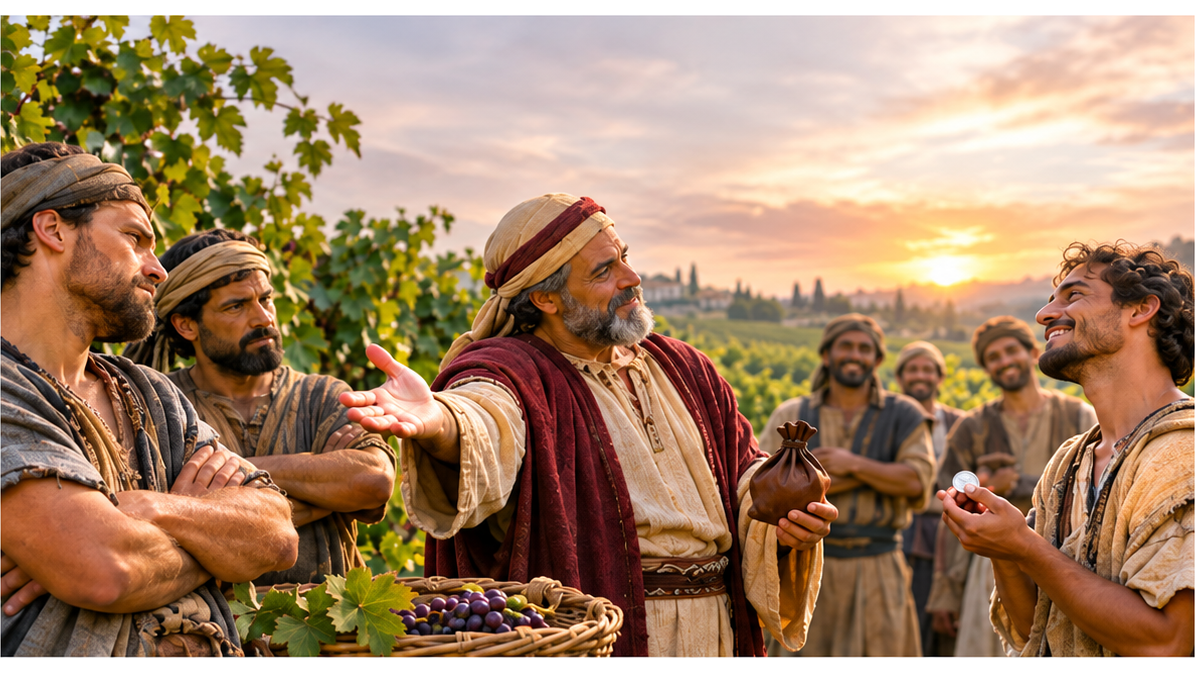
The landowner hires workers at different times throughout the day. The first workers agree to the stated wage, while later workers enter the vineyard at subsequent hours. At the end of the day, the landowner directs that payment begin with those hired last.
When the late workers receive a denarius, the first workers expect more. They have borne the burden and heat of the day, and the equal payment appears to them an inadequate recognition of their greater labor. Their attention moves from the agreement they accepted to the generosity someone else receives.
That movement exposes the danger of comparison. A gift or promise that once seemed satisfactory can become a cause of resentment when another person receives an unexpected kindness. We may be thankful for God’s faithfulness until we decide that His generosity to someone else diminishes what He has given us.
Jesus does not pretend that the workers have labored for the same length of time. The difference is part of the story. The issue is whether the landowner has acted unjustly toward the first workers by choosing to be generous to the last.
Jesus Calls His Followers to Trust His Righteous Generosity
Matthew 20:13–16
The landowner explains that he has kept his agreement. He has not withheld the wage he promised. He also asserts the freedom to give generously from what belongs to him. His kindness to the late workers does not make him unfaithful to the first.
God’s justice and generosity therefore belong together. The parable cannot rightly be used to excuse broken promises, unfair treatment, or neglect of faithful service. The landowner’s defense depends in part on the fact that he has done what he agreed to do.
The equal denarius most likely pictures eternal life shared by those who enter Christ’s kingdom. That is a reasoned interpretation rather than an explicit identification Jesus makes. We should not press the image into a claim that every believer receives identical circumstances, responsibilities, spiritual gifts, or rewards for service.
The central challenge concerns our response to grace. God’s generosity to another person does not reduce His faithfulness to us. His people can rejoice in what He gives without requiring that His kindness always conform to their comparisons.
The final statement about the last and the first returns us to the warning that introduced the parable. Human expectations of precedence cannot govern the King’s gracious dealings with His people.
Gratitude in the Presence of Another Person’s Blessing
Peter needs both the assurance and the correction Jesus gives. The Lord sees what His disciples have surrendered, and His promises are trustworthy. Yet following Him also means learning to rejoice when His goodness reaches someone else in ways we did not expect.
This formation touches ordinary Christian life. We may compare opportunities, recognition, circumstances, or the apparent ease with which another believer receives what we have long desired. Such comparisons can turn attention away from God’s faithfulness and make His generosity seem like a grievance.
The King who promises our future is also the Savior who gives His life to redeem us. Matthew 20:28 directs attention to the Son of Man who serves and gives His life as a ransom. Our service does not purchase His grace. We receive His generosity as people who depend on His saving work.
Gratitude therefore involves more than thanking God for what He gives us. It includes trusting His goodness enough to rejoice when He is generous to others. His faithfulness gives us reason to obey, and His grace gives us reason to celebrate another person’s blessing.
For Reflection
- How does Jesus acknowledge real sacrifice without teaching that sacrifice earns salvation?
- Where has comparison made it difficult to give thanks for God’s faithfulness?
- Why does the landowner’s generosity to the late workers not make him unjust toward the first?
- Whose blessing could you receive with greater joy rather than resentment?
- What costly act of obedience calls you to trust Christ’s promises now?
FOLLOW ME: MADE BY JESUS traces how Jesus calls, teaches, corrects, restores, and transforms Peter into the disciple He intends him to become.
Formation: GRATITUDE — Jesus teaches Peter to trust His promises, receive His generosity with gratitude, and rejoice when that generosity is extended to others.
Study & Teaching Resources
Use the participant handout during class, review the completed notes afterward, and follow the complete Scripture readings in the teaching slides.
Participant Handout (PDF) · Completed Notes (PDF) · Teaching Slides (PDF)
Read Matthew 19:27–20:16 in NASB 1995
Scripture quotations taken from the New American Standard Bible® (NASB), Copyright © 1960, 1971, 1977, 1995 by The Lockman Foundation. Used by permission. All rights reserved. www.Lockman.org