
Glory: Listen to Him
Matthew 17:1–13 · NASB 1995
Handouts & ResourcesFOLLOW ME: MADE BY JESUS — Message 8
Central Truth: The glory of Jesus Christ is revealed, confirming the majesty of the beloved Son whose word we must hear and whose suffering accomplishes God’s redemptive purpose.
Glory on the Road to the Cross
Matthew 17:1–13 follows Jesus’ announcement of suffering, death, resurrection, and coming glory. Peter has struggled to receive that road. Six days later, Jesus takes him with James and John up a high mountain, where they witness a disclosure of His majesty.
The Transfiguration does not replace the mission Jesus has announced. It reveals the glory of the Son who will accomplish that mission. The Father’s command to listen to Him therefore bears directly on the word the disciples have found difficult to receive.
The Son’s Glory Is Revealed
Matthew 17:1–3
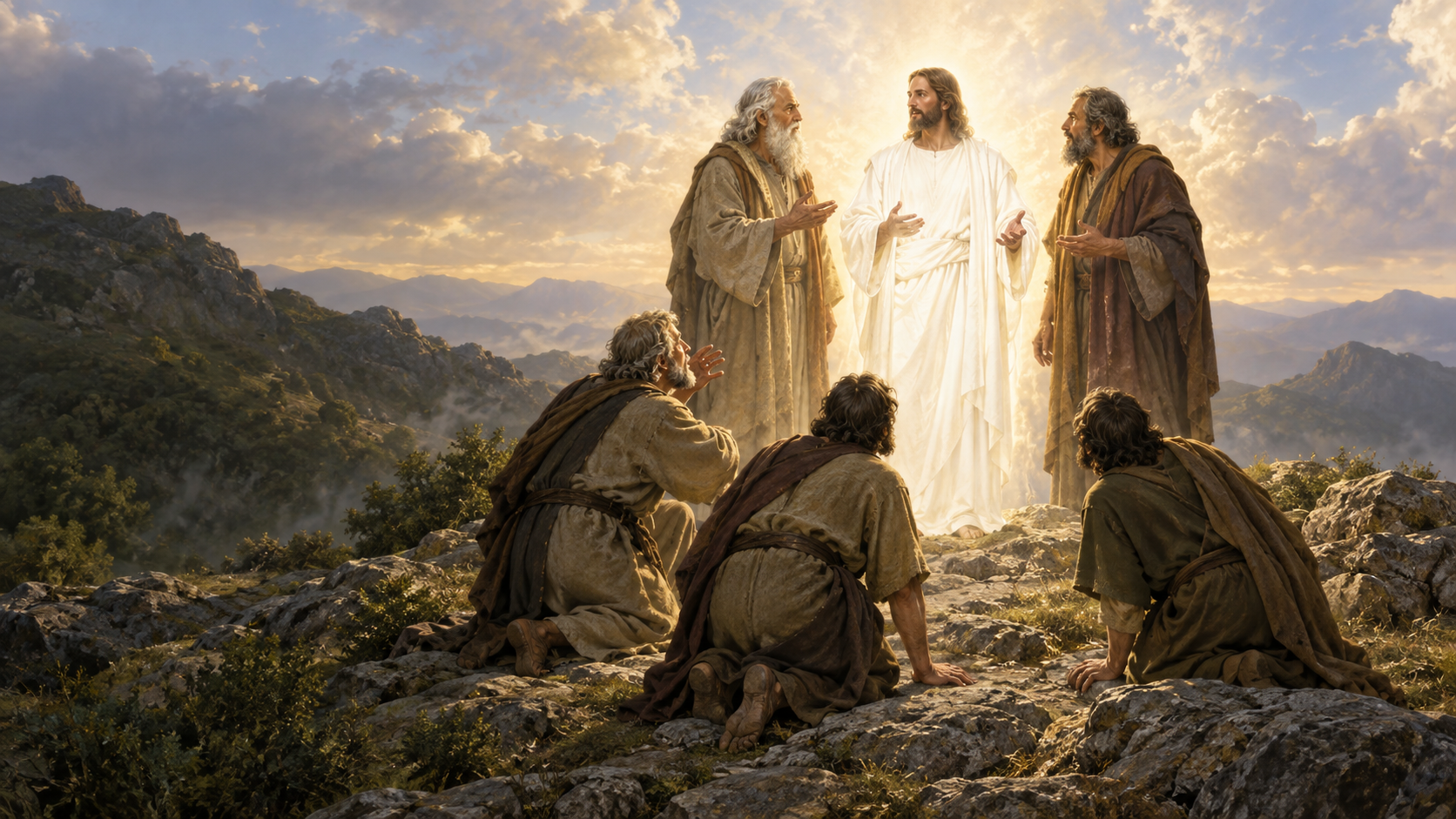
Jesus is transfigured before the three disciples. His face shines like the sun and His garments become white as light. He does not become divine on the mountain. The scene reveals the majesty of the Son they already follow.
Moses and Elijah appear and speak with Him. Matthew tells us of their presence; Luke 9:30–31 identifies their subject as Jesus’ departure, which He is about to accomplish at Jerusalem. Even this scene of glory directs attention toward the work that lies ahead.
The event previews future kingdom glory without being the Second Coming itself. Peter, James, and John receive a true sight of Christ’s majesty within the course of His earthly ministry. Their experience confirms that the announcement of suffering has not diminished His identity or authority.
This guards us against imagining a conflict between the glorious Christ and the crucified Christ. The same Son possesses the majesty revealed on the mountain and willingly proceeds toward the suffering by which He will redeem His people.
The Son’s Authority Is Declared
Matthew 17:4–8
Peter says that it is good for them to be there and offers, if Jesus wishes, to build three tabernacles. His proposal must be read with the other Gospel accounts. Mark describes fear and uncertainty, and Luke notes that Peter does not understand what he is saying.
We should not assume that Peter’s words prove selfish ambition or a desire to speak merely for the sake of speaking. Sincere appreciation of the moment can coexist with incomplete understanding. A wish to remain on the mountain is a possible inference, but Matthew does not explicitly identify it as Peter’s motive.
While Peter is still speaking, a bright cloud overshadows them and the Father identifies Jesus as His beloved Son, with whom He is pleased. He commands the disciples to listen to Him. The Father’s declaration gives Jesus a unique place; the disciples are to receive the word of the Son.
The men fall face down in terror. Jesus comes to them, touches them, and tells them to rise without fear. When they look up, they see Jesus alone. The One whose authority the Father declares is also the One who graciously reassures them.
Listening to Him includes receiving what He has said about suffering. The disciples cannot honor His glory while refusing the mission He reveals. His identity establishes the trustworthiness of His word.
The Son’s Redemptive Mission Continues
Matthew 17:9–13
As they descend, Jesus instructs them not to tell the vision until after the Son of Man has risen from the dead. Their testimony must be related to the resurrection. The mountain is not an invitation to bypass Jerusalem.
The disciples ask about the expectation that Elijah must come first. Jesus explains that Elijah has already come and has not been recognized, and Matthew says that they understand Him to be speaking of John the Baptist. John fulfills the Elijah role in preparation for Jesus.
The question of further future fulfillment is disputed and should not be treated as though this passage resolves every aspect of it. Matthew’s immediate emphasis is clear: the rejection of John provides a sobering connection with the suffering the Son of Man will also undergo.
Christ’s glory does not make the cross unnecessary. Matthew’s later teaching about the ransom of His life and His blood shed for forgiveness makes the saving purpose of His suffering explicit. The disciples must learn to hear both the promise of glory and the announcement of the cross.
Hear the Son Whose Glory Is Revealed
Peter receives more than an unforgettable experience. He receives a clearer view of Jesus and a divine command to listen to Him. The proper response is trust that follows the Son down the mountain as well as reverence before His majesty.
We should receive the same correction in our reading of Scripture. The words of Jesus are not subject to our approval. His glory strengthens our confidence in the mission He accomplishes and the word He gives. We honor the beloved Son by hearing, trusting, and following Him.
For Reflection
- How does the Transfiguration confirm Christ’s identity without replacing His suffering mission?
- Why should we distinguish what Scripture says about Peter from assumptions about his motives?
- Where does the Father’s command to listen to Jesus challenge your preferences?
- What concrete act of obedience would express trust in the glorious Son?
FOLLOW ME: MADE BY JESUS traces how Jesus calls, teaches, corrects, restores, and transforms Peter into the disciple He intends him to become.
Study & Teaching Resources
Use the participant handout during class. Review the completed notes afterward.
DIG DEEPER
DIG DEEPER 01
Moses Died. Elijah Was Taken. Both Appeared in Glory.
Luke 9:30–31 | Matthew 17:1–8
Read Matthew 17:1–13 (NASB 1995)
Read the passage — NASB 1995
MATTHEW 17:1–13 | NASB95
1 Six days later Jesus took with Him Peter and James and John his brother, and led them up on a high mountain by themselves.
2 And He was transfigured before them; and His face shone like the sun, and His garments became as white as light.
3 And behold, Moses and Elijah appeared to them, talking with Him.
4 Peter said to Jesus, “Lord, it is good for us to be here; if You wish, I will make three tabernacles here, one for You, and one for Moses, and one for Elijah.”
5 While he was still speaking, a bright cloud overshadowed them, and behold, a voice out of the cloud said, “This is My beloved Son, with whom I am well-pleased; listen to Him!”
6 When the disciples heard this, they fell face down to the ground and were terrified.
7 And Jesus came to them and touched them and said, “Get up, and do not be afraid.”
8 And lifting up their eyes, they saw no one except Jesus Himself alone.
9 As they were coming down from the mountain, Jesus commanded them, saying, “Tell the vision to no one until the Son of Man has risen from the dead.”
10 And His disciples asked Him, “Why then do the scribes say that Elijah must come first?”
11 And He answered and said, “Elijah is coming and will restore all things;
12 but I say to you that Elijah already came, and they did not recognize him, but did to him whatever they wished. So also the Son of Man is going to suffer at their hands.”
13 Then the disciples understood that He had spoken to them about John the Baptist.
Scripture quotations taken from the New American Standard Bible® (NASB), Copyright © 1960, 1971, 1977, 1995 by The Lockman Foundation. Used by permission. All rights reserved. www.Lockman.org