Confession: You Are the Christ
Matthew 16:13–20 · NASB 1995
Handouts & ResourcesFOLLOW ME: MADE BY JESUS — Message 5
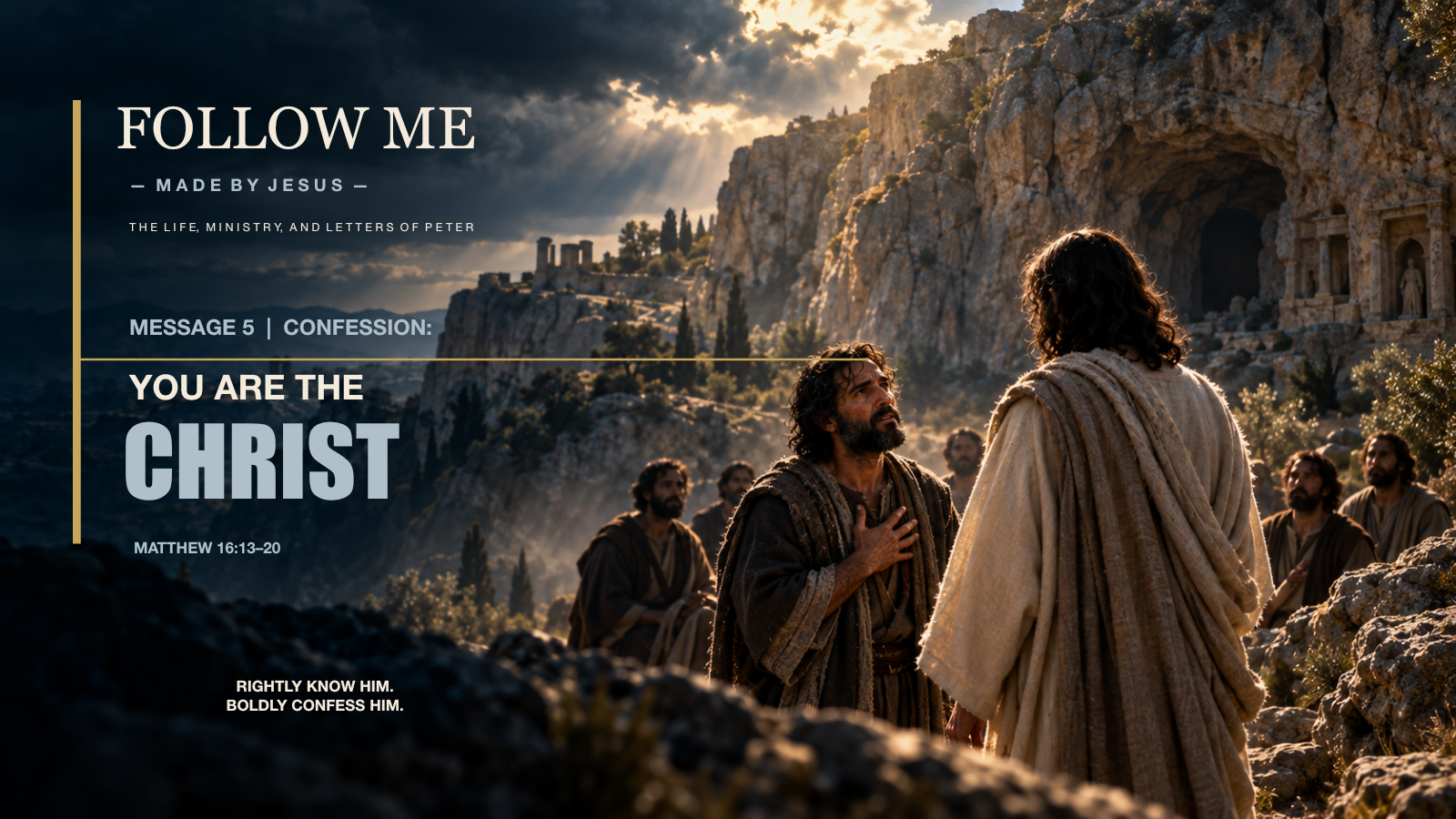
Central Truth: Everything about following Jesus depends on rightly knowing and confessing who He is.
The Question Every Disciple Must Answer
In Matthew 16:13–20, Jesus brings His disciples to a question more important than the opinions surrounding them. In the region of Caesarea Philippi, He asks who people say the Son of Man is. Their answers reflect considerable interest in Him, but none adequately identifies Him.
Jesus then asks for the disciples’ own confession. Peter’s answer becomes a turning point in the account. He truly recognizes who Jesus is, even though the next passage will show how much he still needs to learn about what the Messiah must do.
Jesus Reveals Who He Is
Matthew 16:13–17
The reported opinions compare Jesus with John the Baptist, Elijah, Jeremiah, or another prophet. Such comparisons may sound respectful, but admiration is not the same as rightly knowing Him. Jesus does not leave His disciples at the level of the crowd’s speculation.
Peter identifies Jesus as the Christ, the Son of the living God. His confession recognizes Jesus as the promised Messiah and affirms His unique relationship to the Father. The importance of the answer rests in the identity of the One being confessed.
Jesus declares Peter blessed and attributes this recognition to the Father’s revelation rather than merely human insight. Peter does not stand above other people because he has independently solved a religious puzzle. He has received truth that God has graciously made known.
This challenges both careless assumptions and spiritual pride. We must know the Jesus Scripture reveals rather than construct a figure who reflects our preferences. At the same time, a true confession gives us reason for gratitude to God, not grounds for congratulating ourselves.
Jesus Builds What Belongs to Him
Matthew 16:18
Jesus speaks of Peter, the rock, and the church He will build. Christians have differed over precisely how to understand the rock language. Some emphasize Peter’s confession, others Peter himself in his foundational apostolic role, and others Christ as the ultimate foundation. These readings seek to account for the relationship between Peter’s name, his confession, and Jesus’ promise.
Peter receives a genuine foundational apostolic role, while the controlling declaration remains that Jesus builds His own church. Peter matters because Christ appoints and uses him. The church belongs to Christ and depends upon His authority.
Recognizing Peter’s role does not by itself establish every later claim made concerning his office or successors. Such claims require their own biblical examination. Nor should concern about those claims lead us to remove the real responsibility Jesus gives Peter in this passage.
Jesus also promises that the gates of Hades will not overpower His church. The language directs our confidence toward His power over the forces of death. It does not promise that His people will avoid suffering or that every institution bearing His name will remain faithful. The security of the church rests in its living Lord.
Jesus Entrusts His Work to His People
Matthew 16:19–20
Jesus promises Peter the keys of the kingdom and speaks of binding and loosing in relation to heaven. The images convey real responsibility under the authority of the King. Peter is entrusted with service; he does not become the independent source of the kingdom’s truth or authority.
The relationship to heaven is essential. The authority Jesus gives cannot rightly be used to contradict the will of the One who gives it. Christian ministry remains answerable to Christ, whose Word governs what His people proclaim and practice.
Jesus then instructs the disciples not to announce that He is the Christ. In the unfolding narrative, the Messiah’s identity must be understood alongside the suffering, death, and resurrection He is about to explain. Peter has confessed truly, but he has not yet understood fully.
A True Confession Leads into Continuing Discipleship
Peter’s confession is not the end of his formation. Matthew places it immediately before the disclosure of the road to Jerusalem. The man who rightly identifies Jesus will soon need correction when he resists the mission Jesus reveals.
We should therefore hold conviction and teachability together. Following Jesus requires a true confession of His identity, and it requires continuing submission to His word. We cannot honor Him as the Christ while reserving the right to determine what He ought to do.
The Lord who builds His church remains the center of our confidence. He reveals the truth His people need, gives them responsibilities in His service, and teaches them to depend upon Him. Everything about following Jesus depends on rightly knowing and confessing who He is.
For Reflection
- How does Peter’s confession differ from the crowd’s respectful opinions about Jesus?
- Why should receiving the truth about Christ produce gratitude rather than pride?
- How does Christ’s ownership of the church shape our understanding of ministry authority?
- Where do you need to combine firm confession with a willingness to keep learning from Jesus?
FOLLOW ME: MADE BY JESUS traces how Jesus calls, teaches, corrects, restores, and transforms Peter into the disciple He intends him to become.
Study & Teaching Resources
Use the participant handout during class. Review the completed notes afterward, or open the teaching slides for a visual summary of the lesson.
Didn’t attend the class? Start with the Completed Notes for the fullest public study resource.
Dig Deeper
Read Matthew 16:13–20 (NASB 1995)
Read the passage — NASB 1995
MATTHEW 16:13–20 | NASB95
13 Now when Jesus came into the district of Caesarea Philippi, He was asking His disciples, “Who do people say that the Son of Man is?”
14 And they said, “Some say John the Baptist; and others, Elijah; but still others, Jeremiah, or one of the prophets.”
15 He said to them, “But who do you say that I am?”
16 Simon Peter answered, “You are the Christ, the Son of the living God.”
17 And Jesus said to him, “Blessed are you, Simon Barjona, because flesh and blood did not reveal this to you, but My Father who is in heaven.
18 “I also say to you that you are Peter, and upon this rock I will build My church; and the gates of Hades will not overpower it.
19 “I will give you the keys of the kingdom of heaven; and whatever you bind on earth shall have been bound in heaven, and whatever you loose on earth shall have been loosed in heaven.”
20 Then He warned the disciples that they should tell no one that He was the Christ.
Scripture quotations taken from the New American Standard Bible® (NASB), Copyright © 1960, 1971, 1977, 1995 by The Lockman Foundation. Used by permission. All rights reserved. www.Lockman.org